Published on March 26, 2026
An aortic dissection is a serious condition where a tear develops in the wall of the aorta, the body’s main artery, causing blood to flow between its layers. There are two types: Type A, which occurs in the first part of the aorta near the heart and often requires immediate surgery, and Type B, which happens in the back part of the aorta farther from the heart and can be just as dangerous, especially in older patients.
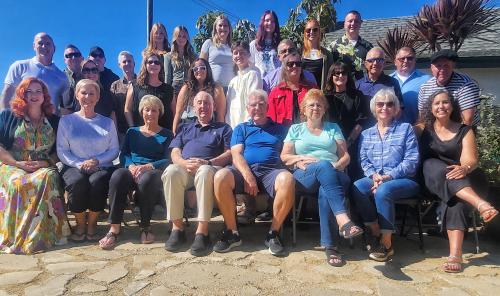
When a type B aortic dissection occurs in a patient with aortic rupture, the mortality is very high. The older the patient is, the less likely they are to survive a ruptured type B dissection. However, 83-year-old Jim Cavener did do just that – survived and thrived. With the assistance of experts in the Comprehensive Aortic Program at MemorialCare Heart & Vascular Institute at Long Beach Medical Center, Jim gets to continue living his long life and making memories with his family.
Triumph Over Loss and Life-Threatening Pain
After losing his wife of 58 years to stage 4 breast cancer, Jim was in a state of grief. While grieving and managing his 30-year hypertension diagnosis, Jim was faced with a life-or-death predicament.
On June 7, 2024, while on the phone with his local bank, sorting out his late wife’s assets, Jim felt a ripping, stabbing, and sharp pain inside his back.
“The pain I felt in my back was surreal,” said Jim. “It was a physical pain I have never experienced before; it was a 12 out of 10 on the pain scale.”
Not knowing what was going on, Jim called his eldest son, David, who is an emergency room nurse and very familiar with these types of symptoms. David told his father that he needed to call 911 immediately because he was likely having an aortic dissection. Jim called 911, and the dispatcher sent emergency medical services to him.
Jim’s Journey to MemorialCare Heart & Vascular Institute
Within a couple of minutes, the paramedics arrived and drove him to a local hospital near his house. There, the doctors examined him and found Jim had bled out nearly half a gallon of blood in his chest and around his aorta. Based on the symptoms, it was confirmed that it was indeed a ruptured type B dissection, a tear in the descending part of the aorta, and it may extend into the abdomen.
Men older than 65 are at greater risk for a type B aortic dissection because there is weakness in the aortic wall from basic wear and tear, which may cause this dissection to occur. Couple that with increased blood pressure, and it creates greater stress on the aortic wall. For an older patient with a 30-year history of high blood pressure, like Jim, the mortality rate quickly rises each hour.
Jim was immediately transported to MemorialCare Heart & Vascular Institute at Long Beach Medical Center because of its advanced technology, latest treatment protocols and the skill of the endovascular specialists to handle this severe case, as well as its well-known Comprehensive Aortic Program.
The Comprehensive Aortic Program at MemorialCare Heart & Vascular Institute offers advanced, minimally invasive heart and vascular procedures with personalized treatment plans, providing patients with the highest quality cardiac care and one of the largest aortic programs in the West Coast. For about a decade, Long Beach Medical Center has been a leader in the development and advancement of aortic surgery, and today the Comprehensive Aortic Program stands at the forefront of treating life‑threatening aortic diseases.
This program is dedicated to the early detection, monitoring and evidence‑based treatment of complex aortic conditions, delivering rapid and accurate care for patients facing acute aortic syndromes such as aortic dissection, ulcer, intramural hematoma and unstable thoracic aortic aneurysm. Using advanced imaging, the program creates individualized treatment plans tailored to each patient’s needs. As a national leader in clinical research and trials, the Comprehensive Aortic Program also offers next‑generation transcatheter aortic procedures, including branched stent grafts for the aortic arch and the thoracoabdominal aortic pathologies, giving hope to patients who are not candidates in most other hospitals.
Life-Saving Treatment for Aortic Dissection
Jim needed an emergent cardiac procedure upon his arrival. Experts in the Comprehensive Aortic Program performed a thoracic endovascular aortic repair (TEVAR), a minimally invasive surgical procedure using the FDA-approve stent-graft to treat the weakened sections of the aorta. The TEVAR procedure immediately opened up the true channel of the aorta and covered the ruptured segment, allowing blood to flow through normally again.
During the TEVAR procedure, a cloth-like mesh material stent graft, chosen based on the size and location of the aorta, was inserted through the specific area where Jim had his aortic rupture and was deployed with disrupting any of the other aortas that are already ruptured.
This life-saving procedure was a complete success, finishing within 45 minutes with no complications.
“We have very unique capabilities at MemorialCare Heart & Vascular Institute to treat extreme cases like Mr. Cavener’s, such as a hybrid cath lab and operating room, and next-generation devices and tools such as laser fenestrations,” says Rodney White, M.D., medical director, Vascular Surgery, MemorialCare Heart & Vascular Institute, Long Beach Medical Center. “The hybrid cath lab allows for both open surgical and endovascular procedures to be performed in one location, which can improve patient outcomes and provide a faster response time.”
Recovery After Aortic Surgery
After the procedure, Jim recovered in the coronary care unit, where the care team included board-certified intensive care specialists who oversaw Jim and took care of him post-operatively. Long Beach Medical Center is one of the few hospitals in Southern California with a 24-hour intensivist in the cardiac care unit, improving and expediting postoperative care.
“The care team was perfect. They were attentive to my dad, took care of him and kept me updated on what was going on. They didn’t do it just because I am a nurse – they truly cared for him because my dad was a person.”
- Jim’s son, David
As one of the most high-performing hospitals according to U.S. News & World Report, MemorialCare Heart & Vascular Institute is a six-time five-star recipient recognized for its excellence in coronary bypass surgery, coronary intervention, treatment of heart attack and heart failure by heart grades, and has recently received the American Heart Association’s Get With The Guidelines® Heart Failure Gold Plus Quality Achievement Award, as well as the American Heart Association/American Stroke Association’s Get With The Guidelines® Stroke Gold Plus Quality Achievement Award. With these achievements and an array of passionate and renowned specialists, patients like Jim are provided with the highest quality care and comfort during their hospitalization.
Jim’s New Lease on Life
Fortunately, Jim’s recovery didn’t take too long. He was discharged that same week and spent time recovering at home, continuing his daily tasks and feeling better than ever.
For his routine check-ups, the care team monitored his recovery through CT scans that helped him evaluate the stent-graft in the previously ruptured aorta to make sure the blood was flowing only to the stent-graft and that his lungs were healed. From there, Jim continues to be monitored every year by his primary care heart doctor and aortic specialist.
While this was a difficult journey for Jim and his family, it brought them closer than ever.
“They gave me and my siblings more time with our dad,” said David. “And for that, I am entirely grateful for the entire team at Long Beach Medical Center.”
And just two years after his life‑saving surgery, Jim is embracing a new chapter with gratitude and energy. He recently returned from a two‑week trip to England and stays physically active and socially engaged through his church community, which continues to be a source of joy and connection.
Jim also shares one message with anyone experiencing any form of chest pain:
“Call 911 immediately.”
He feels extremely fortunate to have come to Long Beach for care and credits his recovery—and the precious moments he now shares with his family—to the team who treated him.
“Everything is because of the care I received here,” Jim says.